

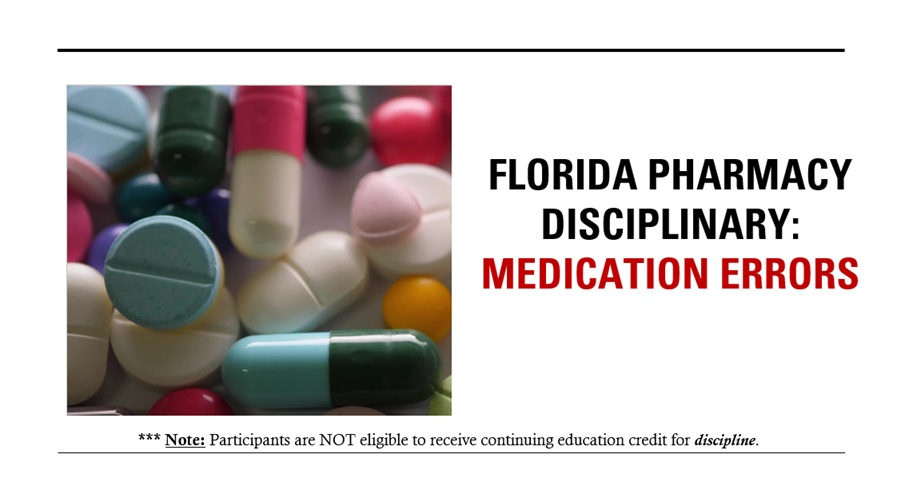
Course Description
This 8-hour Board-Ordered Continuing Education course is designed to satisfy the educational requirements for pharmacists ordered by the Board of Pharmacy to complete Quality Related Event (QRE) training. The course provides instruction on pharmacy error detection and prevention through the review of medication error case studies, common error types and causes, root cause analysis, process and systems analysis, Failure Mode and Effects Analysis (FMEA), human factors, practice management, effective communication, stress management, and Continuous Quality Improvement (CQI) principles and implementation. Participants will also complete an individual self-assessment and a written reflective essay describing what they learned, the impact of the course on their practice, and the changes they will implement to improve medication safety and patient care.
Learning Objectives
At the completion of this activity, participants will be able to: Detect pharmacy errors and identify ways to prevent errors; Outline common error types and causes of errors; Describe root cause analysis and its role in error prevention; Examine process mapping, management and system analysis; Describe failure mode and effects analysis; Compare and contrast the role of human factors on medication errors and those that result from stressful and systematic environments; Provide effective communication skills when dealing with medication errors; Recognize the importance of Continuous Quality Improvement (CQI) rules and implement a CQI program in the pharmacy; Analyze case studies of pharmacists who have made errors (dosing calculations, checking and/or interpreting prescriptions, dispensing errors) and create the necessary steps to avoid errors; Provide the proper resources for the pharmacy to identify and mitigate errors.
Table of Contents
Introduction
Chapter 1: Medication Errors Detection: Anatomy of Error
1. Define Error as a human condition
2. Describe key components of human error
3. Analyze types of human error
4. Evaluate why human errors occur
5. Describe strategies that accumulate data to manage error
6. Evaluate tools shown to mitigate error occurrence
Chapter 2: Medication Errors Prevention
- Moving from REACTION to PATIENT CENTERED PREVENTION
- Define medication errors and key terms associated with patient medication safety
- Describe proactive processes that promote medication safety through prevention
- Describe the application of Failure Mode Effects Analysis (FMEA) to mitigate potential medication errors
- Demonstrate a root cause analysis (RCA) to a quality related medication event
- Recall medication safety strategies that effectively prevent medication errors
Chapter 3: Pharmacy Error Case Study
- Regulatory Resources
- Review Cases
- Discuss Error Prevention
No Comments